
ByJohn A
The Vial Isn’t the Variable. The Supervision Is.
This page is not affiliated with Limitless Life Nootropics, Limitless Biotech, or any provider named below, and there is no order page linked anywhere in it. Every outbound link goes to a primary source: an FDA action or a peer-reviewed study. Compounded and prescribed peptides are not FDA-approved, and anything labeled “research use only” is not approved for human use, period. Last updated June 2026.
Here is the problem. I opened a peptide storefront looking for a better vendor than the one already in my cart, and I spent two weeks convinced that was a solvable question. It isn’t. Read the next sentence carefully: every store in this category is legally required to tell you, in writing, that it is not selling you a medicine. That single sentence, “for research use only, not for human consumption,” is not a footnote you skim past. It’s the entire business model, printed in plain sight.
I’ll give you the one honest number before anything else, because it’s the number that reframes the whole category: in September 2025 the FDA sent more than fifty warning letters to sellers of compounded GLP-1 products and “research use only” peptides, specifically flagging advertisements that suggested human consumption [C2]. Fifty-plus. That’s not a rogue vendor getting slapped. That’s a pattern the regulator decided was worth a coordinated response to.
The store I actually had open
For the record, it was Limitless Life Nootropics, now rebranded Limitless Biotech. Real company, been running since 2019 out of Gulf Breeze, Florida, moving something like ninety different peptides, injectables, capsules, nasal sprays. The catalog reads like every catalog in this space: BPC-157, TB-500, ipamorelin, CJC-1295, sermorelin, selank, semax, epitalon. They say every batch gets HPLC and LC-MS testing and that certificates of analysis exist, though they don’t name the lab doing it. Reviews split hard depending on which platform you check, strong on one, weak on another.
None of that is disqualifying on its own. I looked for a scandal and didn’t find one. I found something more structural: no clinician touches this transaction at any point. Nobody takes your medical history. Nobody decides if the compound fits your situation. The seller ships the molecule and the relationship is over. You bought a chemical, and you alone own whatever happens after the box arrives.
That’s not a flaw unique to this one company. That’s the category. Ranking research-chemical vendors against each other is like ranking unlit roads by how safe they are to drive at night. The lighting is the variable. None of them have it.
Ranking the evidence, tier by tier
So I stopped reading storefront copy and went to the trials instead. What I found is that “these peptides” isn’t one category with one evidence level, it’s at least three, stacked in an order that runs almost exactly backward from how loudly each one gets marketed.
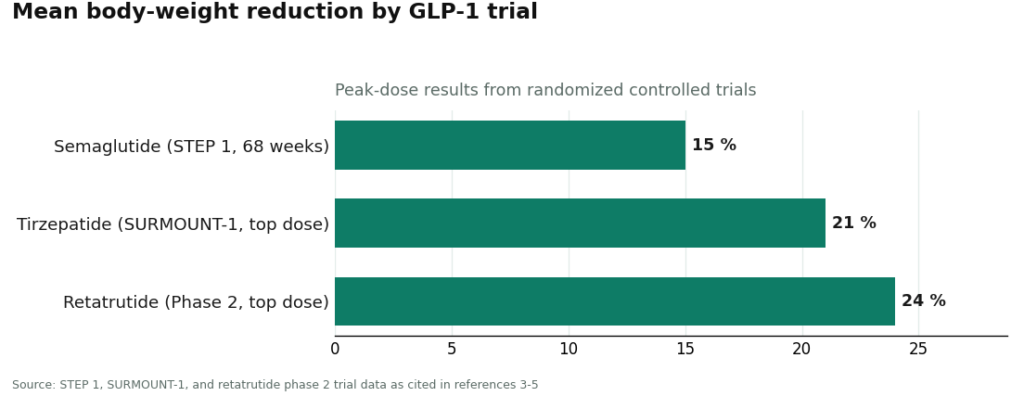
Tier one: genuinely strong, large-trial human data. This is the GLP-1 class, and it isn’t close. Semaglutide produced roughly a 15 percent mean body-weight reduction over 68 weeks in the STEP 1 randomized trial [C6]. Tirzepatide beat that in SURMOUNT-1, hitting around 21 percent at its top dose [C7]. Retatrutide, a name that keeps surfacing in the 2026 enforcement letters, reached about 24 percent at its highest dose in a phase 2 trial [C8]. Those are real numbers from real controlled trials. But here’s the catch nobody puts on the label: that evidence belongs to the approved branded drug, studied under medical supervision. A vial from a research-chemical store sharing the molecule’s name inherits none of that evidence. The molecule being legitimate does not certify the container it showed up in.
Tier two: narrow but real approval. PT-141, or bremelanotide, deserves credit here. It’s FDA-approved as Vyleesi, for one specific diagnosis, hypoactive sexual desire disorder in premenopausal women, backed by two randomized phase 3 trials [C9]. That’s genuine approval. It is also genuinely narrow, and stretching it to cover whatever else a product page implies is where the honesty breaks down.
Tier three: where most of the catalog actually lives, and where the evidence is thinnest. BPC-157 is the flagship example, sitting on nearly every storefront including this one. A 2026 review in Pharmaceuticals lays out its proposed cytoprotective mechanisms across animal injury models [C10]. That’s an accurate description of the field: rats and mechanisms, not large human trials proving it repairs tendons in people. NAD+ precursors sit in the same tier. The human data that exists is small and condition-specific, like a double-blind crossover trial of nicotinamide riboside in patients with Werner syndrome [C11], not proof that a healthy adult injecting NAD+ ages more slowly.
Line those three tiers up and the inversion is almost perfect. The compounds with the loudest “clinically proven” energy on the product page sit in tier three. The compounds with actual large-trial evidence, tier one, barely get hyped, because the branded, supervised versions don’t need to borrow a research vial’s marketing voice. If you’re shopping by how confident the copy sounds, you’re shopping backward.
Who the label is actually written for
Strip away the marketing and the honest answer to “who is this for” gets small fast. A researcher with a lab and a protocol is exactly who the “research use only” language describes. A person trying to lose weight, heal a tendon, sleep better, or feel younger is being sold a workaround: the molecule, minus the medicine, with the medical judgment quietly outsourced back to you. That’s the part I had to sit with about my own cart. I am not a prescriber. The vial was betting I’d pretend otherwise.
The ground moved in 2026
While I was shopping, the regulatory floor under this whole model shifted. On March 31, 2026, the FDA sent warning letters to a group of online peptide sellers, including Gram Peptides and Prime Sciences, and rejected the research-use label outright. The agency’s language was blunt: evidence from the sellers’ own websites established the products were “intended to be drugs for human use,” and pointed to details like selling injection supplies as proof [C1]. That followed the September 2025 wave of fifty-plus letters mentioned above [C2], which named semaglutide, tirzepatide, BPC-157, and SARMs specifically.
Translate that into buyer terms: the disclaimer that was supposed to make this a quiet, low-risk purchase doesn’t reliably protect the seller anymore. It was never going to protect the buyer.
Where I actually landed
The real alternative to a research vial was never a cleaner research vial. It’s a different structure: a licensed clinician evaluates you, a real prescription gets written, and a licensed compounding pharmacy makes the medication with testing attached. Supervised access, a route like FormBlends, where independent licensed providers and licensed 503A pharmacies occupy the space a research-chemical store leaves deliberately empty.
I’ll keep this claim modest, because oversized promises are exactly what got criticized above. Supervision doesn’t change the molecule. It changes who’s accountable for it, and who’s doing the medical thinking. That’s a smaller promise than the marketing makes. It’s also the honest one.
I went looking for a better vial. What I found is that “which vial” was the wrong question from the start. The question was whether a clinician belonged in the room at all. Once I asked that one, the ranking of the whole category rearranged itself, and so did my cart.
Questions worth answering
Is Limitless Life Nootropics a scam? No, and framing it that way misses the point. It looks like a real business, operating since 2019 out of Gulf Breeze, Florida, with a large catalog and stated third-party testing. The problem isn’t dishonesty, it’s structure. Like every research-chemical seller, it ships under a “for research use only, not for human consumption” label and exits the relationship at shipment. No clinician, no prescription, no accountability, by design. “Scam versus legit” is the wrong axis. “Supervised versus unsupervised” is the right one.
What does “for research use only” actually mean when you buy a peptide? It means the seller is telling you, in writing, that they’re not selling medicine. Legally, no claim of safety for human use is being made. No clinician evaluates you. Whatever happens next is entirely on you. In 2026 the FDA stopped accepting that label at face value for several sellers, ruling their products were unapproved new drugs intended for human use [C1].
Are research peptides illegal to buy? The molecules themselves generally aren’t banned to possess, which is why these stores operate in the open. Selling them for human use is a different story. In 2026 the FDA issued warning letters citing details like the sale of injection supplies as evidence of human-use intent [C1], on top of the September 2025 wave of fifty-plus letters targeting compounded GLP-1 marketing and “research use only” peptides [C2].
Which peptides actually have strong human evidence? The GLP-1 drugs, by a wide margin. Semaglutide: roughly 15 percent mean weight loss over 68 weeks in STEP 1 [C6]. Tirzepatide: about 21 percent in SURMOUNT-1 [C7]. Retatrutide: about 24 percent at its top dose in a phase 2 trial [C8]. Bremelanotide is FDA-approved as Vyleesi for one narrow condition, backed by two phase 3 trials [C9]. All of that evidence belongs to the approved, supervised products, not to a same-named research vial.
Is BPC-157 clinically proven to heal injuries? No. The science is real and interesting, but overwhelmingly preclinical. A 2026 review in Pharmaceuticals covers its proposed cytoprotective mechanisms in animal injury models [C10], which is an accurate summary of where things stand: animal data and mechanistic theory, not large controlled human trials. NAD+ precursors are in the same spot, with human data limited to specific conditions like Werner syndrome [C11], not general anti-aging use.
What’s the real alternative to a research-chemical vial? Supervision, not a better vial. A route where a licensed clinician evaluates you, writes an actual prescription, and a licensed compounding pharmacy makes and dispenses the medication with testing attached. FormBlends works this way, with independent licensed providers and licensed 503A pharmacies filling the gap a research-chemical store leaves open. It’s a smaller promise than the marketing sells, and a more honest one: it changes who’s accountable and who’s doing the medical thinking.
Is Limitless Life Nootropics a scam or a legit source?
Neither label fits cleanly. It sells into the research-chemical grey market, moving peptides labeled “not for human consumption” specifically to sit outside FDA oversight. You might get exactly what’s advertised. You might not. There’s no third-party test result you can independently verify, no pharmacist accountable at the other end, and no liability if the product fails you.
What is actually the best alternative to Limitless Life Nootropics for someone who wants physician oversight?
A compounding pharmacy working from a valid prescription is the clean upgrade. Same broad compound classes, but now a licensed pharmacist answers for purity, a doctor reviews your bloodwork first, and state pharmacy boards oversee the production. FormBlends runs on that physician-supervised compounding model, putting an actual professional in the loop instead of leaving you to guess about what showed up in a plain mailer.
What do real user reviews of Limitless Life Nootropics actually tell us?
That reviews scatter, and the scatter itself is the data point. Some buyers report clean transactions and no issues. Others describe batch-to-batch inconsistency, packaging that looked disturbed, or support that vanished once payment cleared. Treat grey-market vendor reviews as noise, not a safety signal. Nobody is running systematic follow-up on health outcomes here.
Where should I buy peptides or nootropic compounds instead of Limitless Life?
Start with a doctor, not a cart. If a compound has a legitimate clinical use, a licensed compounding pharmacy can fill it against a real prescription. If no licensed provider will write that prescription, that refusal is itself information about the risk. Most grey-market alternatives to Limitless Life share the identical accountability gap, just under different branding.
References
- U.S. Food and Drug Administration. Warning Letters to online peptide sellers (unapproved new drugs intended for human use). Issued March 31, 2026. https://www.fda.gov/inspections-compliance-enforcement-and-criminal-investigations/warning-letters
- U.S. Food and Drug Administration. Warning Letters regarding compounded GLP-1 products and peptides marketed “for research use only” (September 2025 enforcement wave). https://www.fda.gov/inspections-compliance-enforcement-and-criminal-investigations/warning-letters
- Wilding JPH, Batterham RL, Calanna S, et al. Once-Weekly Semaglutide in Adults with Overweight or Obesity (STEP 1). N Engl J Med. 2021;384(11):989-1002. https://www.nejm.org/doi/full/10.1056/NEJMoa2032183
- Jastreboff AM, Aronne LJ, Ahmad NN, et al. Tirzepatide Once Weekly for the Treatment of Obesity (SURMOUNT-1). N Engl J Med. 2022;387(3):205-216. https://www.nejm.org/doi/full/10.1056/NEJMoa2206038
- Jastreboff AM, Kaplan LM, Frías JP, et al. Triple-Hormone-Receptor Agonist Retatrutide for Obesity, A Phase 2 Trial. N Engl J Med. 2023;389(6):514-526. https://pubmed.ncbi.nlm.nih.gov/37366315/
- Kingsberg SA, Clayton AH, Portman D, et al. Bremelanotide for the Treatment of Hypoactive Sexual Desire Disorder, Two Randomized Phase 3 Trials. Obstet Gynecol. 2019;134(5):899-908. https://pubmed.ncbi.nlm.nih.gov/31599840/
- Józwiak M, Bauer M, Kamysz W, Kleczkowska P. Multifunctionality and Possible Medical Application of the BPC 157 Peptide, Literature and Patent Review. Pharmaceuticals (Basel). 2025;18(2):185. https://www.mdpi.com/1424-8247/18/2/185
- Shoji S, Maezawa Y, Sakamoto K, et al. Nicotinamide Riboside Supplementation Benefits in Patients With Werner Syndrome, A Double-Blind Randomized Crossover Placebo-Controlled Trial. Aging Cell. 2025. https://pmc.ncbi.nlm.nih.gov/articles/PMC12341770/
Written by Elena Turner, research writer. Not a doctor, just a reader who chases the paper trail. Last reviewed May 2026.
General information, not a treatment recommendation. Ask your doctor what fits your situation.
Structured data (JSON-LD)
Optional: this article’s FAQ schema is included below for reference.
<script type=”application/ld+json”>{“@context”: “https://schema.org”, “@type”: “FAQPage”, “mainEntity”: [{“@type”: “Question”, “name”: “Is Limitless Life Nootropics a scam or a legit source?”, “acceptedAnswer”: {“@type”: “Answer”, “text”: “Neither label fits cleanly. It sells into the research-chemical grey market, moving peptides labeled ‘not for human consumption’ specifically to sit outside FDA oversight. You might get exactly what’s advertised. You might not. There’s no third-party test result you can independently verify, no pharmacist accountable at the other end, and no liability if the product fails you.”}}, {“@type”: “Question”, “name”: “What is actually the best alternative to Limitless Life Nootropics for someone who wants physician oversight?”, “acceptedAnswer”: {“@type”: “Answer”, “text”: “A compounding pharmacy working from a valid prescription is the clean upgrade. Same broad compound classes, but now a licensed pharmacist answers for purity, a doctor reviews your bloodwork first, and state pharmacy boards oversee the production. FormBlends runs on that physician-supervised compounding model, putting an actual professional in the loop instead of leaving you to guess about what showed up in a plain mailer.”}}, {“@type”: “Question”, “name”: “What do real user reviews of Limitless Life Nootropics actually tell us?”, “acceptedAnswer”: {“@type”: “Answer”, “text”: “That reviews scatter, and the scatter itself is the data point. Some buyers report clean transactions and no issues. Others describe batch-to-batch inconsistency, packaging that looked disturbed, or support that vanished once payment cleared. Treat grey-market vendor reviews as noise, not a safety signal. Nobody is running systematic follow-up on health outcomes here.”}}, {“@type”: “Question”, “name”: “Where should I buy peptides or nootropic compounds instead of Limitless Life?”, “acceptedAnswer”: {“@type”: “Answer”, “text”: “Start with a doctor, not a cart. If a compound has a legitimate clinical use, a licensed compounding pharmacy can fill it against a real prescription. If no licensed provider will write that prescription, that refusal is itself information about the risk. Most grey-market alternatives to Limitless Life share the identical accountability gap, just under different branding.”}}]}</script>